https://offcourse.org
ISSN 1556-4975

Published by Ricardo and Isabel Nirenberg since 1998
The Dada Dedication Event, by Joachim Frank
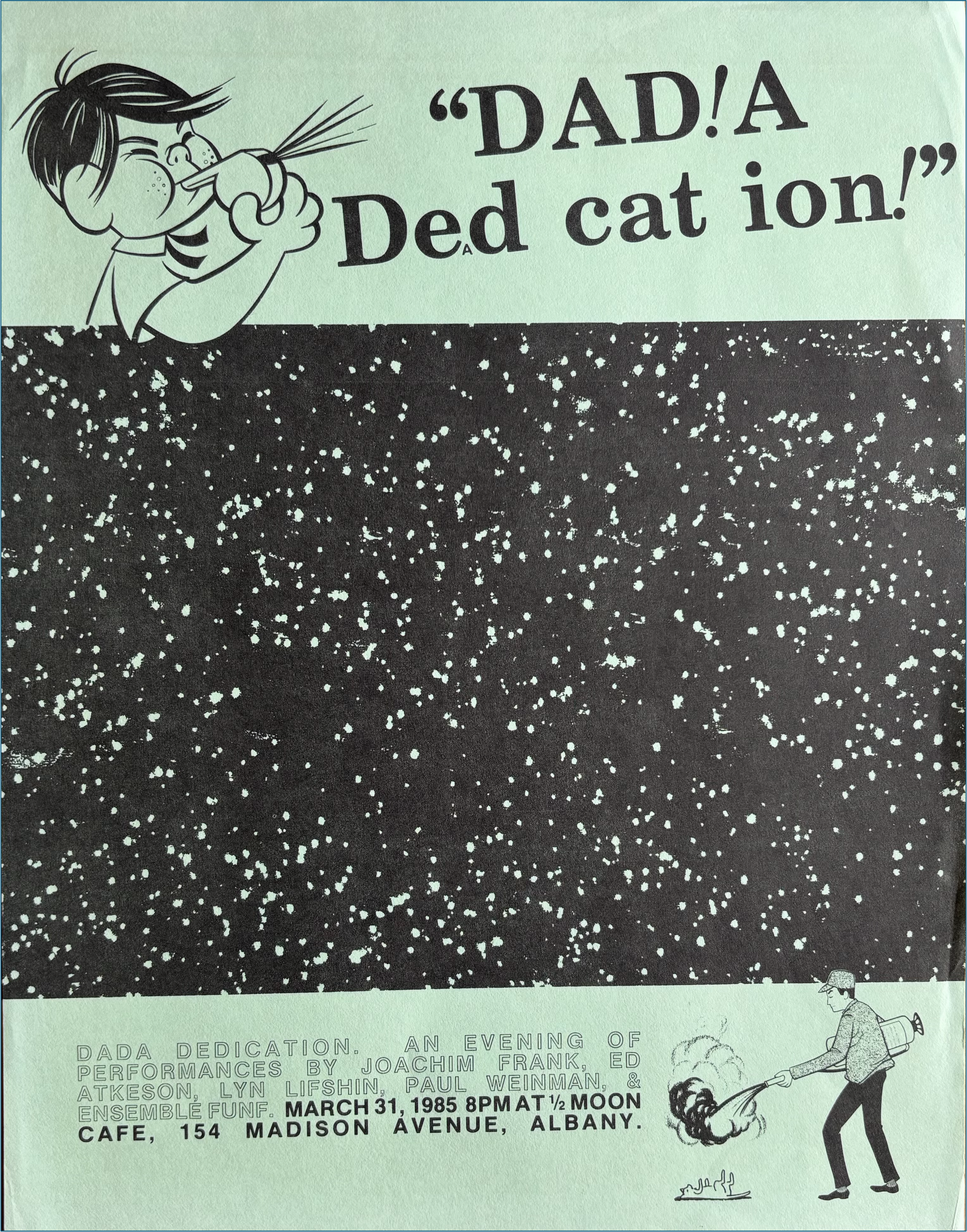
DADA Dedication was a WORKSPACE event in Albany, in 1985, spurred by the passing of Marcel Janco on April 21, 1984 (aged 88) in Ein Hod, Israel. According to Wiki, he was a “Romanian and Israeli visual artist, architect and art theorist. He is known as the co-inventor of Dadaism and a leading exponent of Constructivism in Eastern Europe.” As MOMA currently celebrates the lifetime work of Marcel Duchamp with a major exhibition, this may be a good time for recalling events that have similarly put the focus back on the time before and during WWI.
There is something else that makes this reflection so timely. We live through a time that brings into focus the lack of control over our lives, over our own destiny. Decisions are being made well over our heads by billionaires lacking a moral compass, by a man entirely devoid of morality and humanity, and his opportunistic sycophants. AI, imposed on us by large corporations without accountability, is on the verge of hijacking our culture, our language, our very elections – the little control the populace might be able to exert over their lives. The resulting disconnect along with the sense of lack of agency is so strong that the new generation has mostly given up on planning their future, trading it in for immediate gratification.
The time during WWI – apart from the obvious historical differences of staging – was quite similar in these features since it was a generation entirely disconnected from the political discourse of the time. There was a sense of doom, and a sense of “whatever,” since the stage of world affairs, then as now, was overcrowded with self-serving actors and, for most people, out of reach. It was during this time of desolation, this sense of complete powerlessness, that DADA was born.
True to the currents that gave rise to DADA, the FLUXUS movement and WORKSPACE, the Albany event of March 31,1985 was staged to resurrect the spirit of DADA and, with it Janco’s, one of its co-founders. I know from the records that a video was recorded on one of the large clumsy devices of the time, but the whereabouts of the video are missing. The two low-quality pictures reproduced here may well be frames captured from that video. In my files I also found exchanges of letters with Jean Browne of the Jean Browne Archive in Iowa, with Stephen Foster, David Cole and the late poet Lyn Lifshin, originally from Schenectady, who flew in from Virginia.
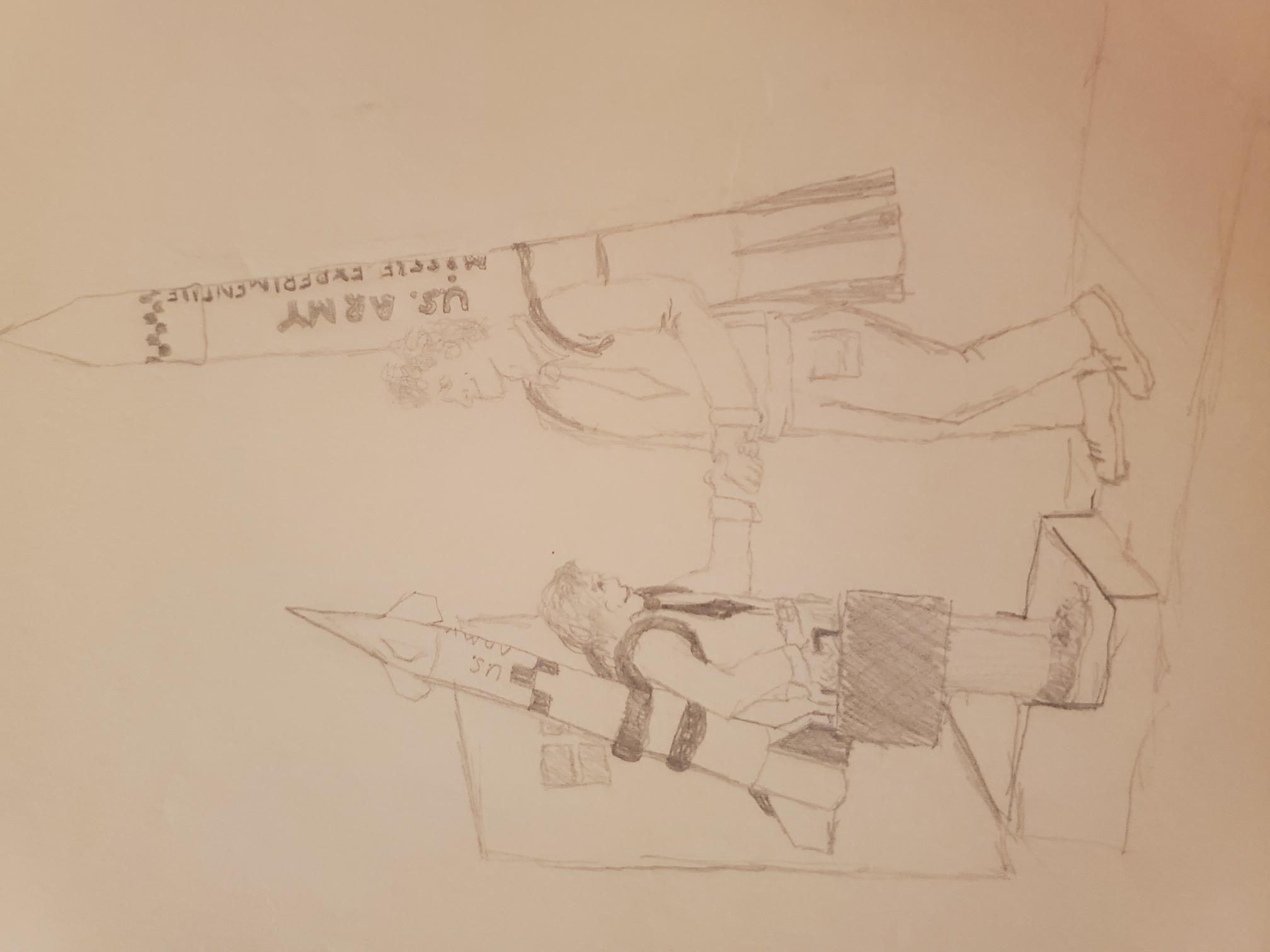
Because of a disturbing news story on March 27 of this year 2026, I would like to draw attention to my performance that night in 1985. Equipped with googles and a cardboard mockup of a missile launcher on my back, I asked everybody to join me in a universal armament to fend off our ubiquitous enemies. My son, who turned 13 on the day of the performance, made a pencil drawing that has both of us similarly equipped, him standing on a little pedestal to level our heights, shaking hands with me, smiling.
The news story I was referring to bore the headline “Trump DOJ Refuses to Rule Out Second Amendment Right to Nuclear Weapons.” [Tess M. Fardon and Shira Lauren Feldman, SLATE, March 27, 2026]. In other words, a satire intended to show the absurdity of the Second Amendment has moved into the range of possibility? It is as though 300 years after Swift’s Modest Proposal, published in 1729, the slaughter of children to feed the hungry might get serious consideration by the FDA.
Speech given at the DADA DEDICATION EVENT March 31, 1985 by Joachim Frank
Almost 70 years ago, during Spring of 1916, the burghers of Zürich were amused, astonished, disturbed, even outraged by the activities of a group of extraordinary young men and women who had suddenly appeared in their midst. The original group comprised Hugo Ball, Emmy Jennings, Hans Arp, Tristan Tsara, Richard Huelsenbeck, and Marcel Janco. They started performances and what we would today call happenings at Cabaret Voltaire and somehow created the spirit of DADA. This spirit, once kindled, would spread like wildfire through Paris, Berlin, Cologne and New York, forever changing perceptions about the purpose and meaning of art.
It was the death of Marcel Janco a year ago that re-directed attention to this movement. Our performance tonight, a DADA Soirée, is dedicated to his memory.
A DADA event in Albany, New York? Where snow ploughs don’t plough; where 25,000 tulips cannot be found in Spring because they grow in the wrong direction; where buses are not allowed to run between the airport and downtown because everybody would stop taking taxicabs; where the taxpayers pay $100,000 to remove a sign that a major bank erected illegally! In other words, what an absurd place to put up a DADA performance!
When we come together tonight to make the DADA spirit tap-dance and fart the old ways, we cannot help but direct our attention to the political atmosphere, seventy years ago, that made DADA possible, even necessary. Acts on stage that were perceived by the burghers as insane were in fact directed against the insanity of mass slaughter in the First World War; they were acts of ultimate human sanity. Stephen Foster and Rudolf Kuenzli write, “Whereas most of European poets and painters joined war propaganda in glorifying the war as the climax of European culture, the Dadaists attacked and attempted to undermine the cultural values and social myths in the name of which the nonsensical massacre was promoted. In this sense the DADA activities can be seen as a demystification and radical questioning of all cultural idols, social taboos, and values. Through persistent breaking of the cultural norms that guided society the Dadaists attempted to emancipate their audience from myths that resulted in the massacre of war …” [Dada Spectrum : the Dialectics of Revolt, Kuenzli, Rudolf E., Introduction by Stephen C. Foster and Rudolf E. Kuenzli, Coda Press, Madison, WI 1979, ISBN : 093095601X]
Today’s world has more than a superficial similarity – imminent mass slaughter, a powder keg waiting for a cinder, insane piling up of weapons of mass destruction. Just the other day, our great salesman [reference is to Roland Reagan] has sold us twenty-two “peace-keepers” – tools indeed for producing ultimate peace.
The world today calls for a similar outcry expressing our outrage, combining all our moral, spiritual and artistic forces. NO MORE BUSINESS AS USUAL, because the usual business is just part of a big doomsday machine.
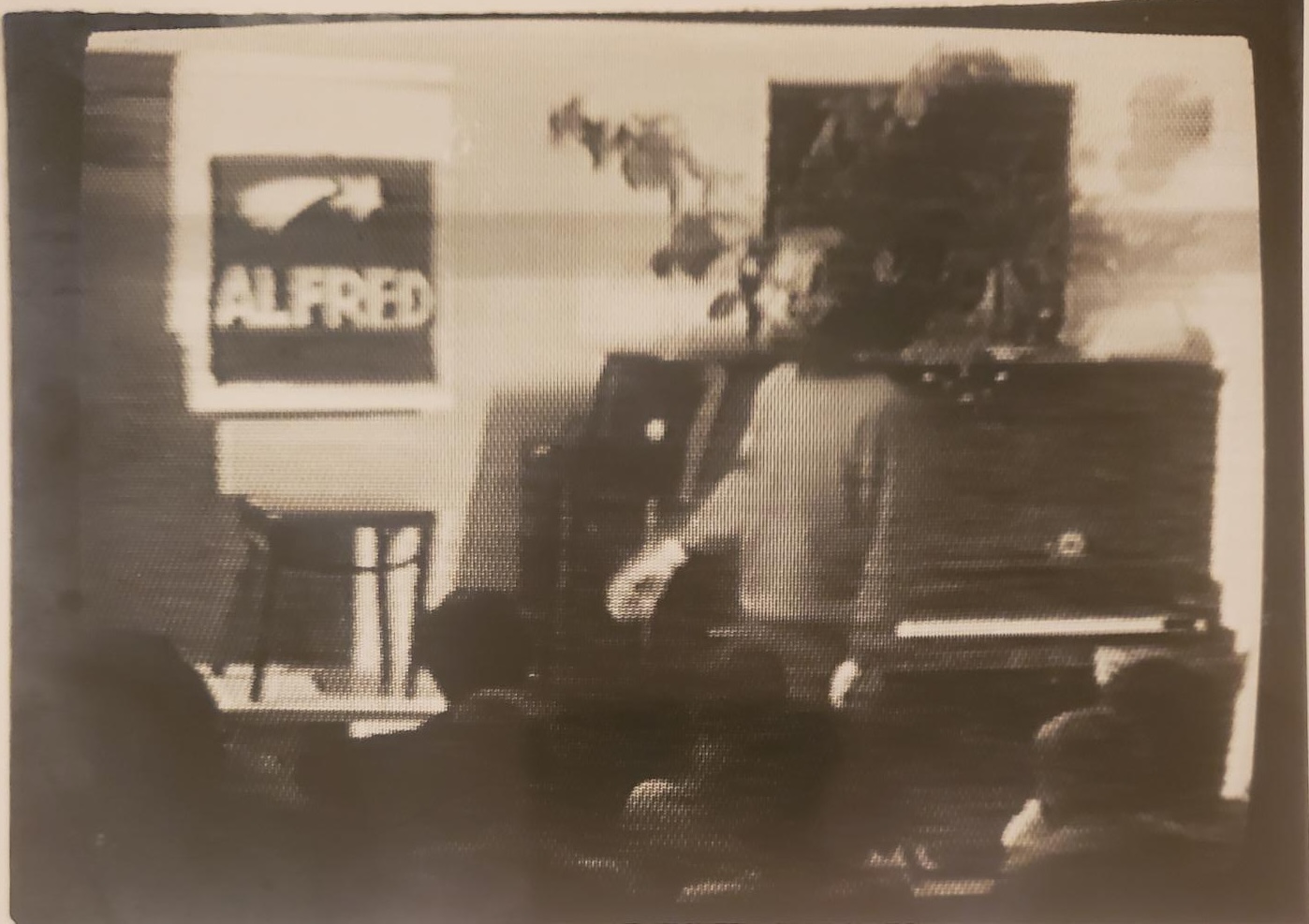
Ed Atkeson, presenting the story of Ubu Roi by Alfred Jarry
These were some definitions of DADA:
“DADA is a celebration of life” [unknown source]
“DADA is a new type: a mixture of man, naphtaline, sponge, animal made of ebonoite and beefsteak, prepared with soap for cleansing the brain. Good teeth are the making of the stomach and beautiful teeth are the making of a charming smile. Halleluiah of ancient oil and injection of rubber.” [Tristan Tsara, cited in Coutts-Smith p. 69]
“DADA is an emotional, social and political condition.” [Coutts-Smith, Kenneth, DADA, Studio Vista London,1970]
DADA, the meaning of the word:
“The tail of a holy cow” (Kru); “The cube” or “The mother” (dialect in a certain area in Italy); “a hobby horse” or “a nurse” (Russian and Romanian)
“DADA, this agent of immediacy and destruction …” [Lucy Lippard, quoted in Stephen Foster and R Kuenzli, DADA spectrum]
“DADA: a movement in art and literature based on deliberate irrationality and negation of traditional artistic values; also: the art and literature produced by the movement.” [Webster’s New Collegiate Dictionary.]
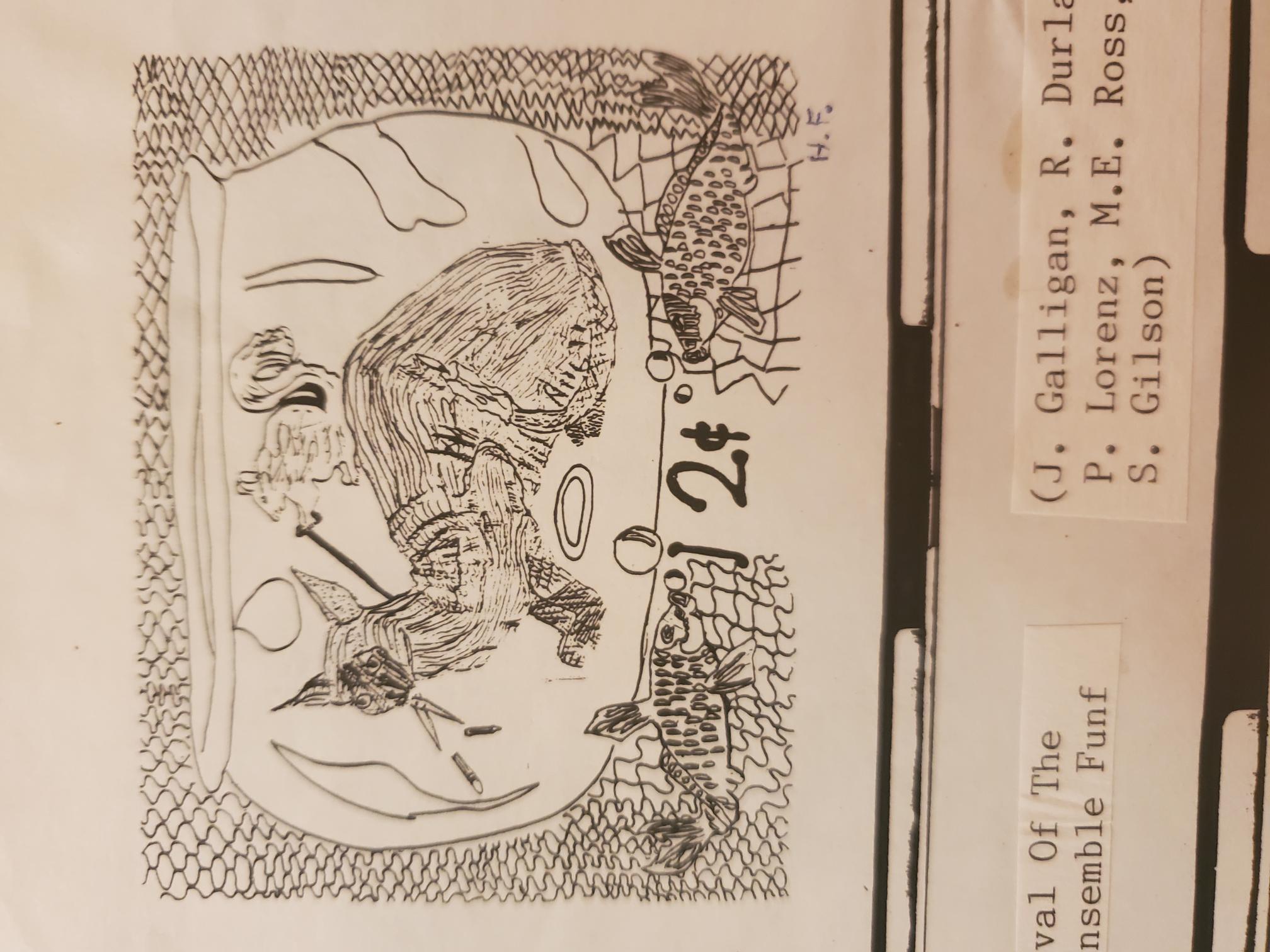
Cat in a fishbowl – design of a 2c stamp by Hosea Frank, used in the advertisement of the event
A few words about Janco and how he was perceived by his contemporaries.
“Janco danced, recited and showed his art in the Cabaret Voltaire. I see him today as one of the great pioneers of our movement, a man with many talents but without arrogance, always helpful and never interfering with other persons’ ambitions. But the best of him was, and still is, his warmth, his affection for his friends, his loyalty to Dadaism, which he understood deeply and profoundly.” [Richard Huelsenbeck, in Motherwell’s Anthology, now cited from second ed., 1989.]
“Are you still singing that diabolical song about the mill in Hirza-Pirza, shaking your gypsy curls with wild laughter, my dear Janco? I haven’t forgotten the masks you used to make for our DDada demonstration. They were terrifying, most of them daubed with bloody red. Out of cardboard, paper, horsehair, wire and cloth, you made your languorous fetuses your Lesbian sardines, your ecstatic mice …” [Hans Arp, ibid]
In Janco’s own words, “DADA was anything but a hoax; it was a turning on the road opening wide horizons to the modern mind. It lasts and will last as long as the spirit of negation contains the ferment of the future.” [Marcel Janco, ibid]
“We had lost confidence in our culture. Everything had to be demolished. We would begin again from a tabula rasa. At the Cabaret Voltaire we begun by shocking the bourgeois, demolishing his idea of art, attacking common sense, public opinion, education, institutions, museums, good taste; in short, the whole prevailing order.” [Marcel Janco, ibid]
[Robert Motherwell, ed.: The Dada Painters and Poets. An Anthology, Second Edition, Harvard University Press 1989; ISBN 9780674185005]
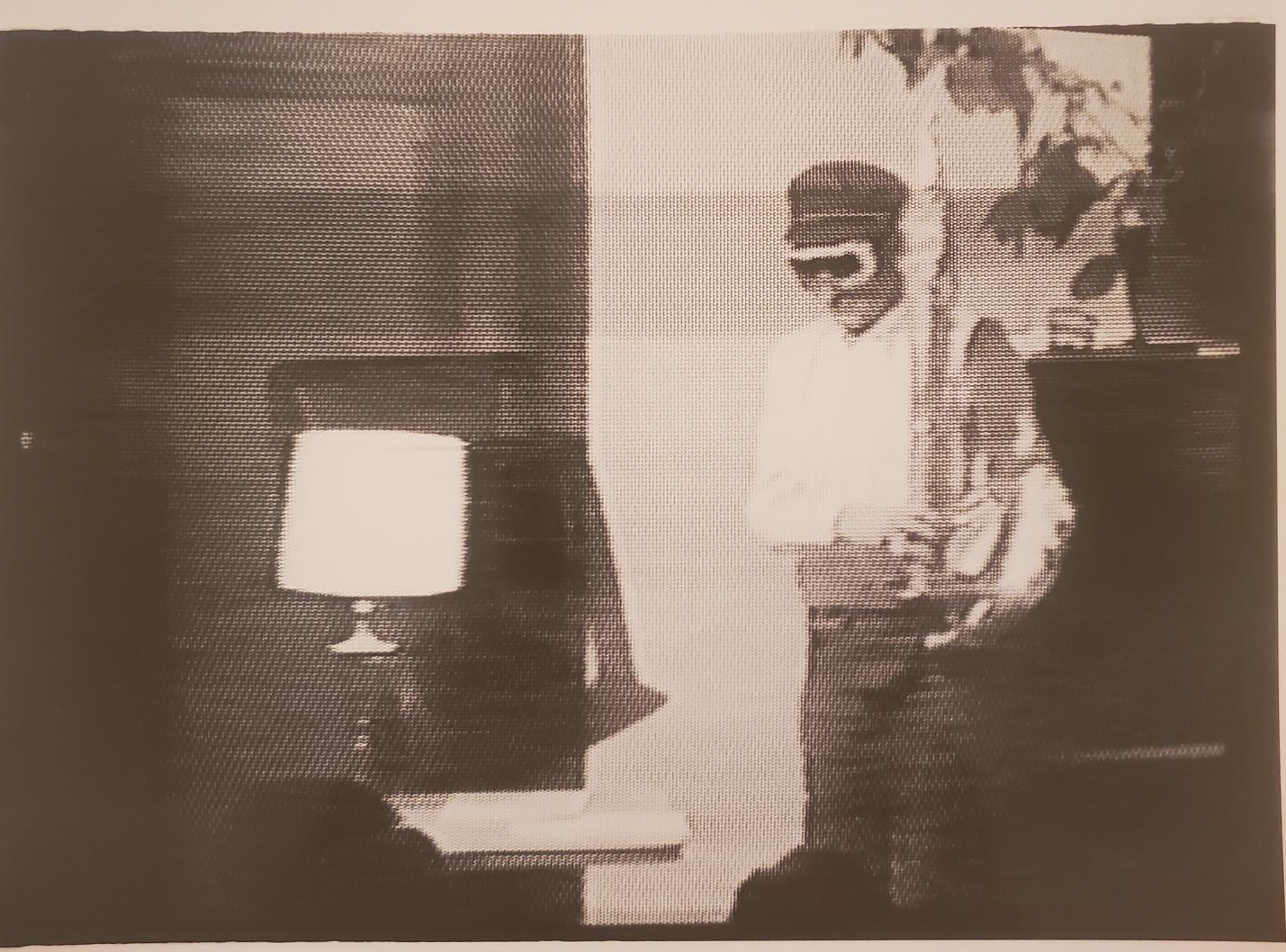
Joachim Frank’s performance with his personal missile
A satirical essay by R. Nirenberg, “Dada in Albany, NY” appeared in Offcourse in the Summer of 2002. It refers to a DADA-themed poetry soirée in the Fall of 2001 in the Albany house of Pierre Joris and his wife Nicole Peyrafitte.
Joachim Frank is a German-born scientist and writer living in New York City and Great Barrington, MA. He took writing classes with William Kennedy, Steven Millhauser, Eugene Garber, and Jayne Ann Philipps. He has published a number of short stories, poems and prose poems in, among other magazines, Eclectica, Offcourse, Hamilton Stone Review, Conium Review, StepAway Magazine , and Wasafiri. Frank is a recipient of the 2017 Nobel Prize in Chemistry. His first novel, "Aan Zee,” appeared in 2019. He just published his second novel, "Ierapetra or His Sister’s Keeper". Frank’s website franxfiction.com runs a blog about everything and carries links to all his literary work.